
What the Standard covers
AS 4970:2025 — Protection of trees on development sites — sets out how trees are retained, protected and integrated through development. It is the current edition and it supersedes AS 4970:2009.
It is worth being clear about what a Standard is and is not. It is not a law, and it does not approve anything. It becomes binding when a council condition, a planning scheme or an approval requires compliance with it, which in South East Queensland is common. What it provides is a consistent method, so that two arborists assessing the same tree arrive at comparable figures and a council reading two reports can compare them.
The Standard itself is a copyrighted document. Adams Arboriculture works from it as technical reference material and will not reproduce or distribute it — no passages, no figures, no downloads. What follows is the process it describes, written independently.
A calculator, a report or a fence line does not make a project compliant. Compliance is determined by the approval and the authority that issued it.
The sequence it describes
The Standard runs in an order, and most of the trouble on development sites comes from taking it out of order — most often by assessing impact before anyone has looked at the trees, or by fencing to a number before the assessment that number feeds.
- Preliminary tree assessmentWhat is on and adjoining the site, in what condition.
- Preliminary Arboricultural Report (PAR)The design-stage document, while the layout can still change.
- Development design reviewThe proposal considered against what the trees require.
- Arboricultural Impact Assessment (AIA)The impact of the specific proposal on the trees.
- Tree Protection Specifications (TPS)What protection is required, and to what standard.
- Tree Protection Plan (TPP)That protection drawn for the site and the works.
- Monitoring and certificationInspections through construction, and sign-off at completion.
The zones, and where the numbers come from
Three terms do most of the work, and they are routinely used as though they were one thing.
The Notional Root Zone is calculated: trunk diameter at 1.4 metres, in metres, multiplied by twelve, floored at 2 metres and capped at 15. The Structural Root Zone is calculated differently, from the diameter immediately above the root buttress flare — that diameter multiplied by fifty, raised to the power of 0.42, multiplied by 0.64, with a 1.5 metre minimum.
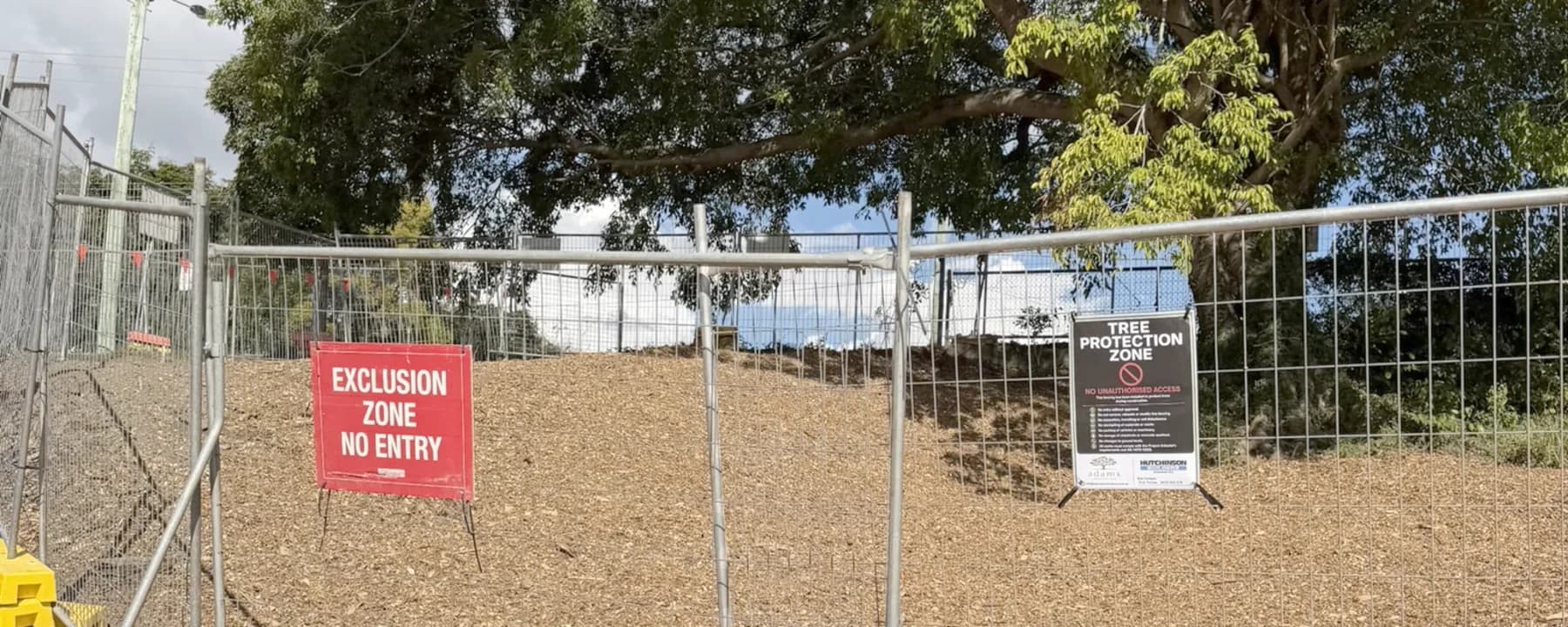
The Tree Protection Zone is not calculated at all. It is determined by the project arborist after considering the tree, the site and the proposed works, with the Notional Root Zone as the starting point. Treating the calculated figure as the final zone is the single most common error on a development site.
- Minor encroachment10% of the NRZ area or less, and clear of the Structural Root Zone.
- Moderate encroachmentMore than 10% and up to 20%, clear of the Structural Root Zone.
- Major encroachmentMore than 20%, or anything intersecting the Structural Root Zone.
Where the 2009 edition still comes up
AS 4970:2009 is superseded, and presenting it as current would be wrong. It is still relevant reading, though, because approvals outlive editions.
Older development approvals, council conditions and existing documentation reference the 2009 terminology, and a condition written against it does not update itself when a new edition is published. Reading what an older approval requires means understanding the edition it was written under, then preparing current work against the current Standard.
If your condition cites AS 4970:2009, send the wording through rather than assuming it has been superseded in practice. What the condition requires is a separate question from which edition is current.