
What a Tree Protection Zone actually is
A Tree Protection Zone is the area around a retained tree that is set aside and protected while construction happens. In practice it is what gets fenced, what may not be driven over, stored on, cut into or dug through, and what a site supervisor is accountable for keeping intact.
It exists because the part of a tree most easily destroyed by a building site is the part nobody can see. Roots sit in the top layers of soil and spread well beyond the canopy. Compaction from repeated traffic, a service trench cut through the wrong side, or spoil stockpiled over the root plate can kill a tree years after the works finish, long after anyone connects the two events.
AS 4970:2025 is the current Standard covering the protection of trees on development sites. It supersedes the 2009 edition, which is still worth reading when an older approval or council document references it, but should never be presented as current.
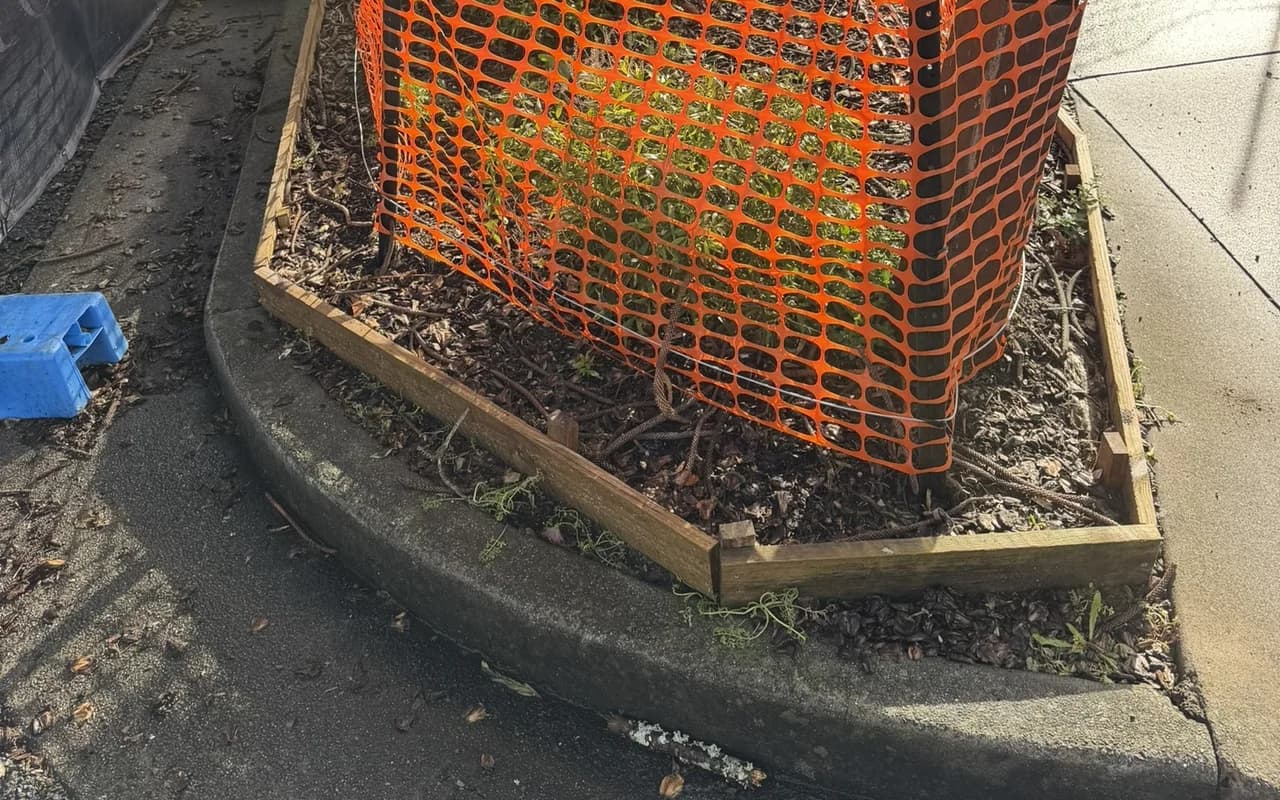
A TPZ is not a no-go area by default. It is a managed area — some works can occur within it, under conditions, with the project arborist involved.
The Notional Root Zone is where the calculation starts
Under AS 4970:2025 the starting point is the Notional Root Zone. It is calculated from the trunk diameter measured at 1.4 metres above ground — diameter at standard height, or DSH.
The NRZ radius is the trunk diameter in metres multiplied by twelve, with a floor of 2 metres and a ceiling of 15 metres. The area is the circle that radius describes. That is the whole calculation, and it is deliberately blunt: it is a consistent, repeatable figure that everyone on a project can arrive at from one measurement.
What it is not is a statement about where that particular tree's roots actually are. Root systems follow water, soil and opportunity, not geometry. The NRZ is a defensible default that the assessment then works from.
- Measured at 1.4 metresDiameter at standard height, taken on site rather than estimated from a photograph or a plan.
- Radius = diameter in metres × 12A 600 mm trunk gives a 7.2 metre radius.
- Floored at 2 m, capped at 15 mSmall trees still get a working zone; very large ones do not scale indefinitely.
- Area = π × radius²The figure encroachment is later measured against.
The Structural Root Zone is a different thing
The Structural Root Zone is the smaller area immediately around the trunk that holds the tree up. It is about stability rather than health, and it is calculated differently — from the trunk diameter measured immediately above the root buttress flare, not at 1.4 metres.
The SRZ radius is that diameter multiplied by fifty, raised to the power of 0.42, multiplied by 0.64, with a minimum of 1.5 metres. The awkwardness of the formula is the point: stability does not scale linearly with trunk size.
The distinction matters because the two zones carry different consequences. Work that clips the outer NRZ is a manageable impact to be assessed. Work that cuts into the SRZ goes to whether the tree stays standing, which is why any encroachment intersecting it is treated as major regardless of how small the percentage looks.
SRZ and NRZ are not interchangeable, and neither is the TPZ. Where an approval names one of them specifically, that is the one that applies.
How encroachment is classified
Encroachment is any part of the proposed works that intrudes into the Notional Root Zone, expressed as a percentage of the NRZ area. AS 4970:2025 sorts it into three bands, and the classification shapes what happens next.
The percentages are only half of it. An encroachment that intersects the Structural Root Zone is major no matter how small the area, and a minor classification is not a straight percentage test where recent encroachment into the NRZ has already occurred — an area that has been cut into before does not have the same tolerance as one that has not.
- Minor10% of the NRZ area or less, and clear of the Structural Root Zone.
- ModerateMore than 10% and up to 20%, and clear of the Structural Root Zone.
- MajorMore than 20%, or any encroachment that intersects the Structural Root Zone.
- Compensatory areaFor minor and moderate encroachments, an equivalent area considered elsewhere around the tree. Informational — it does not redraw the final TPZ by itself.
Who determines the final TPZ
The project arborist does, after considering the tree, the site and the works actually proposed. The calculated Notional Root Zone is the input to that judgement, not the output of it.
This is the single most common misunderstanding on a development site. A number produced from a trunk measurement gets written onto a plan, fencing goes up on that line, and everyone proceeds as though the question is settled. It usually is not — the tree may warrant more room on one side and less on another, existing hard surfaces may already have determined where roots are, and the proposed works may need conditions the number cannot express.
Adam can be engaged as project arborist through construction: reviewing works around retained trees, supervising inside protection areas, attending root investigations and vac-ex, and carrying out root pruning where it is appropriate.
No calculator, including ours, can tell you that a proposal complies, that council will approve it, or that a tree is safe. Those are assessments, and they happen on site.
Where the standard calculation does not apply
Palms and multi-stemmed trees do not take the standard single-stem calculation. The supplied Standard does not support applying it to them, and Adams Arboriculture will not substitute an invented method — no averaging of stem diameters, no summing them.
For those, and for trees with significant prior encroachment, the answer is an assessment rather than a formula. Send the address and a photograph of the trunk and Adam will tell you which situation you are in.