
The headline
AS 4970:2025 — Protection of trees on development sites — supersedes AS 4970:2009. It is the current edition, and current work is prepared against it.
The 2009 edition has not become irrelevant, though, and treating it that way causes its own problems. Approvals outlive editions: a condition written in 2019 against the 2009 Standard still requires what it requires, and reading it properly means understanding the edition it was written under.
So the practical position is two-handed. Prepare new work to 2025. Read older approvals in the language they were written in.
AS 4970:2009 must never be presented as the current Standard. It must also not be dismissed, because a live approval may still reference it.
The terminology that moved
The most visible changes for anyone working with these documents are in what things are called. The 2025 edition introduces and formalises terms that either did not exist in the earlier language or were used loosely.
- Preliminary Arboricultural Report (PAR)Formalised as the design and planning stage document, distinct from an impact assessment.
- Notional Root Zone (NRZ)The calculated zone derived from trunk diameter, and the starting point for determining the TPZ.
- Tree Protection Specifications (TPS)Named alongside the Tree Protection Plan, covering what protection is required and to what standard.
- Arboricultural Impact Assessment (AIA)The current term for assessing the impact of a proposed development on the trees.
- Development design reviewThe proposal considered against what the trees require, as a named step.
- Monitoring and certificationInspection through construction and sign-off at completion, as part of the described process.
The distinction that catches people
The one worth internalising is between the Notional Root Zone and the Tree Protection Zone, because in casual use they get collapsed into a single number and they are not the same thing.
The Notional Root Zone is calculated: trunk diameter at 1.4 metres, in metres, multiplied by twelve, floored at 2 metres and capped at 15. That is arithmetic, and anyone can arrive at it from one measurement.
The Tree Protection Zone is determined, by the project arborist, after considering the tree, the site and the proposed works — with the NRZ as its starting point. Writing the calculated figure onto a plan and fencing to it is the most common error on a development site, and it is the error the terminology exists to prevent.
Encroachment, and why the SRZ overrides the percentage
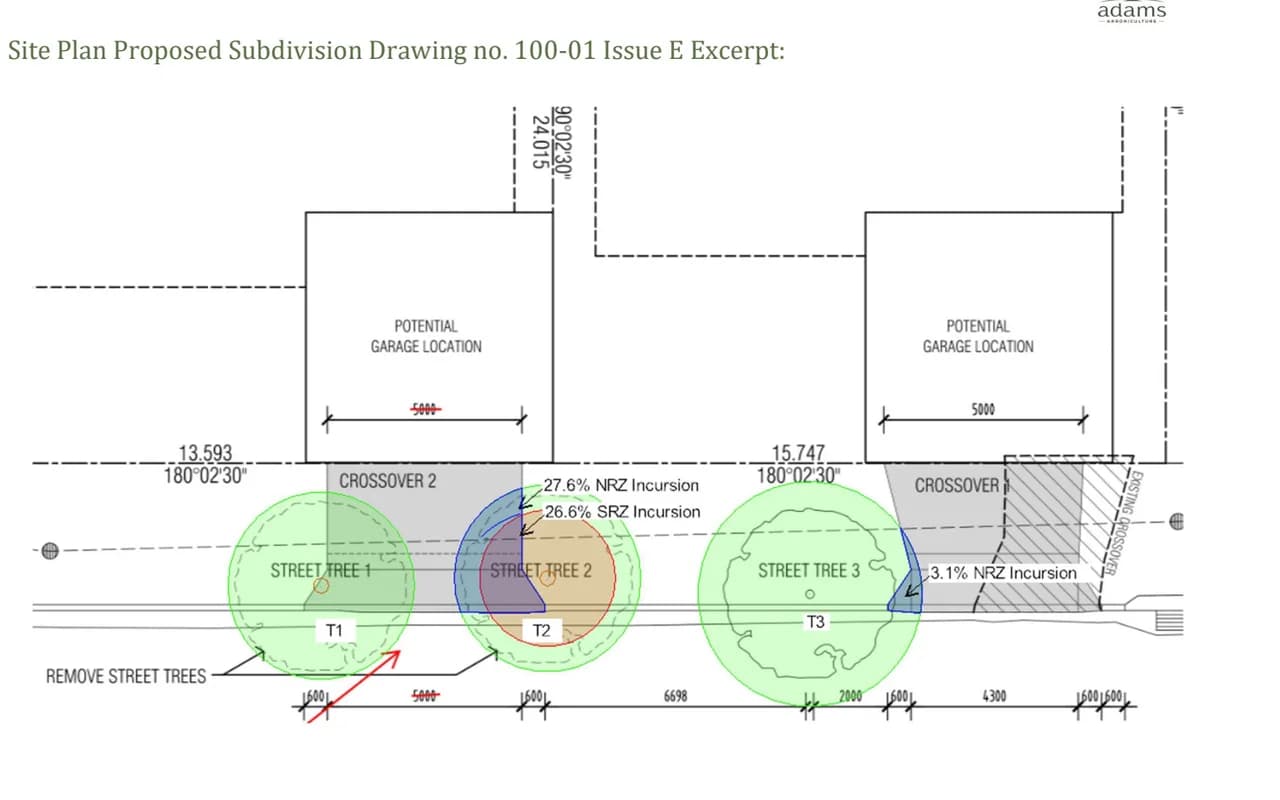
Encroachment into the Notional Root Zone is classified by proportion of its area: ten per cent or less is minor, more than ten and up to twenty is moderate, more than twenty is major.
The part that is easy to miss is that any encroachment intersecting the Structural Root Zone is major regardless of the percentage. A works footprint clipping a small share of the outer zone and one running beside the trunk can produce the same number and completely different consequences, because the roots involved are doing different jobs.
There is a further consideration where the root zone has already been encroached previously — an area cut into before does not carry the same tolerance as one that has not.
What this means in practice
If you hold an approval that cites the 2009 edition, it still requires what it names. Send the wording through rather than assuming it has been superseded in practice — what the condition requires and which edition is current are two separate questions.
If you are commissioning new work, it is prepared against AS 4970:2025. And if a report you have been given uses 2009 language for current development work, that is worth a question.
The Standards are licensed, copyrighted documents. Adams Arboriculture works from them as technical reference material and will not reproduce or distribute them — no passages, no figures, no downloads.